Indonesian Sumatra Bener Meriah – Gayo Aalamin – Typica Wet-hulled “Jasmine” Co-Ferment Infusion
Info
Purchased from: Burman Coffee
Origin: Aceh, Sumatra
Farm: Central Sumatera Coffee (CSC)
Varietals: N/A
Grade: N/A
Purchase Date: 2026-09-02
Purchase Cost: $48.42
Purchase Gram: 1369g
Used Gram: 342g
Remaining Stock: 1027g
Last Roasted: 2026-09-12
Link to original listing: Link
Notes from supplier website:
This is one unique coffee. We have carried only a few Co-Fermentation coffees in the past: some have loved them, some have not, but it is a fun and genuinely unusual offering for home roasters. Part high-quality Indonesian coffee, part floral science experiment. The processing is bold enough that the crowd will be split, and we found a lot of joy drinking it. Be ready for new tastes, because these co-ferments are far from traditional.

Co-fermenting is rare on its own, and co-fermenting an **Indonesia** is close to one of a kind. Most of the anaerobic and co-ferment experimentation happens in Central and South America, but these Indonesian lots are right up there. Co-fermenting means adding some other fruit or flower into the fermentation tank while the coffee is processing, a bit like brewing a beer or a fruit wine but with coffee.

This is an estate-grown lot from **Aceh Province**, Sumatra’s most famous and prolific region for specialty wet-hulled profiles. Unlike almost all other wet-hulled coffee, this microlot uses multiple fermentation additives (**yeast and powdered jasmine flower**) to reach a totally distinct, heavily flavored cup with marmalade sweetness and fresh jasmine aromatics. Coffee grows all over Aceh and is especially concentrated in **Bener Meriah regency**. The vast majority is smallholder grown and gradually consolidated by local processors and millers, who blend batches between one another until an exporter buys them up. **Central Sumatera Coffee (CSC)** is the exception: they run a 100-hectare estate right in Bener Meriah, where they control genetics, harvesting and post-harvest to the detail. Coffees like this one, luxuriously creamy, floral and perfumed with the fragrance of fresh jasmine, are only possible in the hands of exacting processors like CSC.

---

## Flavor Profile
### Jasmine · Lemon / Citrus · Marmalade · Herbal Cocoa · Creamy Body

Clean lemon and citric fruit lead, then fade into a jasmine kick, balanced by an earthy herbal-cocoa base that complements rather than competes. Semi-sweet overall with a lot of complexity. Piping hot it reads like jasmine tea, but with fuller body, creamier mouthfeel and more kick in the aftertaste.

---

## Roasting Notes

Lower chaff levels, fairly even roasting, a couple of off beans, but for a Sumatra an easier coffee to roast. Surface color darkens quickly, so make sure you see bean expansion before hitting the cool button. For lighter roasts we give it an extra little push, and there can be a couple of late cracks; too light risks a stronger herbal note. For fuller roasts, keep it before second crack or bitter notes start mixing in. A slight sheen on the bean surface, smoke, or any sign of second crack: cool it out.

---

## Sumatra’s Aceh Province

Aceh (pronounced AH-CHEY) is the northernmost province of Sumatra. Its highland territory, surrounding Lake Tawar and the central city of Takengon, is considered the epicenter of one of the world’s most unique coffee terroirs. Farms here are managed with the experience of many generations of cultivation, while also harmoniously woven into the surrounding tropical forest: loud canopies, and fields almost impenetrably thick with coffee plants, fruit trees and vegetables, all constantly flushing with new growth. Year-round mists and rain showers never cease, farm floors are spongy and deep with layered biomass, and almost every square meter of the region seems to exude life. Nothing is ever still, including coffee ripening, which occurs ten months out of the year.

## Central Sumatera Coffee

Central Sumatera Coffee (CSC) is a young group with young leadership, founded in 2015 by Enzo Sauqi Hutabarat while he was an urban university student. Aware of the growing demand across greater Indonesia for Sumatra’s best coffees, he gravitated toward Aceh as a culture and a potential business environment. Until 2020 CSC sold coffee only domestically; from 2021 they began to export as well, selling to the Middle East, Europe and Asia, and finally, in 2024, to the United States for the first time via Royal Coffee.

CSC buys coffee from smallholders like a typical processor does, but they also operate three large estates of about 100 hectares each: one in Bener Meriah, where this lot was produced, plus two others in North Sumatra province near Lake Toba, and one in Bali. Their farms are organized varietally, which lets them maintain genetic separations through harvest and processing.

---

## Abyssinia & Gayo 2: The Genetics

Typical smallholder coffee in Aceh tends to be a blend of cultivars, most of them catimor hybrids, and that gives much of the area’s coffee a set of common characteristics that can be hard for a single producer to transcend. In CSC’s case they have the genetic isolation, and the volume from such a large estate, to produce something unique, even with processing styles similar to the collectors and co-ops around them. This estate in particular is planted with newly planted **Abyssinia** seedlings (most likely the AB7 or “Rambung” variety) and what is called **Gayo 2** or “Borbor”, a poorly-defined cross between Timor hybrid and Bourbon. These trees are less than six years old and very productive.

---

## The “Jasmine Process” at the Estate

CSC manages processing on their own estates. The Bener Meriah estate employs 30 pickers during harvest months and 6 specialists for processing. Most of their estate coffee is wet-hulled in the traditional fashion, but this microlot received two significant additional steps, blending multiple fermentation techniques to augment the final cup, and was ultimately processed as a semi-washed.

After picking, the cherry was first held in nylon bags for 16 hours to let the fruit soften and internal sugar content peak. After this brief cherry “maceration”, the coffee was depulped and moved to fermentation tanks, where CSC added yeast as an inoculating agent and powdered dried jasmine flower to co-ferment with the sticky parchment.

Once the blended fermentation cycle was complete, the coffee was patio-dried until internal moisture reached 35%, after which it was wet-hulled and the raw beans dried further to a final 11-12% moisture content. From there the coffee was mechanically milled, hand sorted and bagged for export.
Roast Batches
Sep 12 2026
Roast Details
| Roast Level | Time to FC | Drop Time | Charge Temp | Charge Weight | Final Weight | Loss % | Indoor Temp | Indoor Humidity |
|---|---|---|---|---|---|---|---|---|
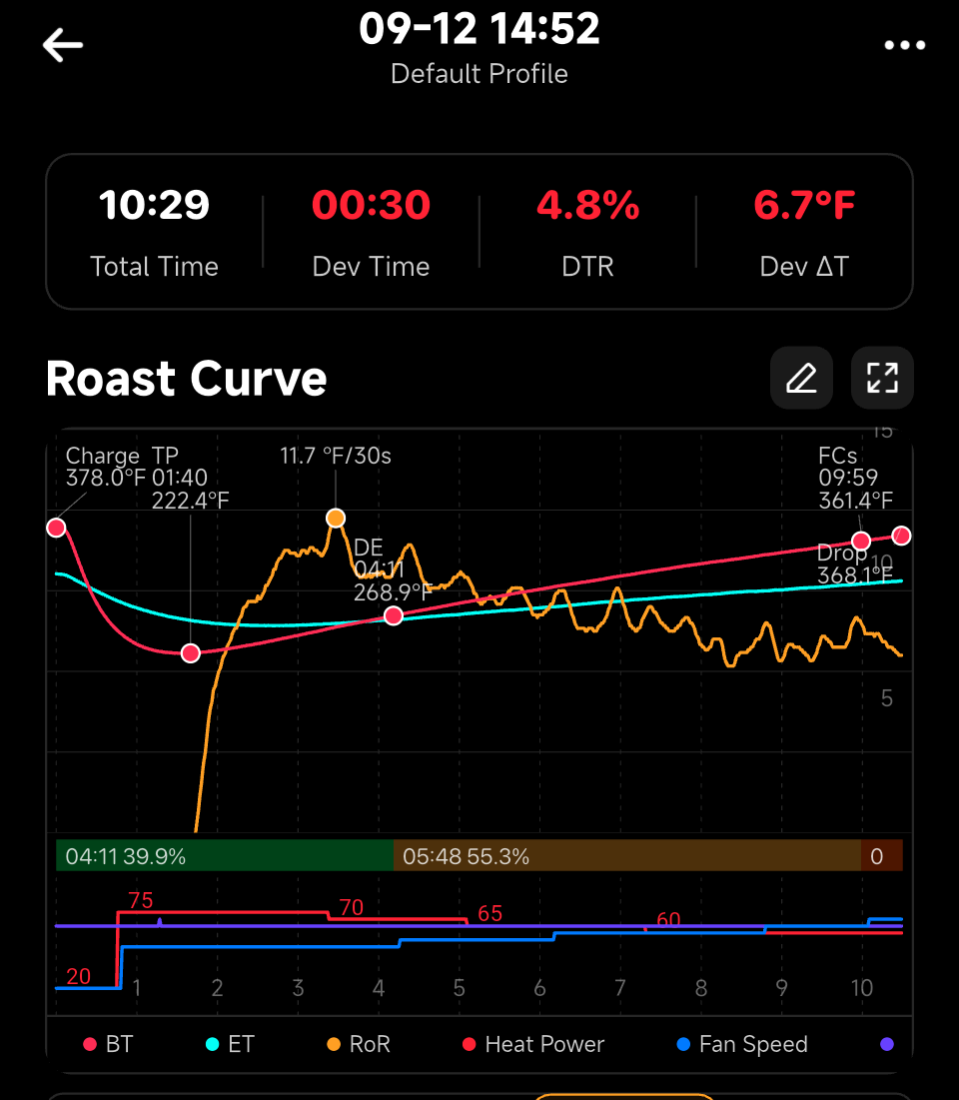
| Light | 9:59 | 10:29 | 378°F | 342g | 303.9g | 11.1% | 79°F | 62% |
Notes
- These greens smell so strongly of Jasmine
- This fades pretty quick during early half of the roast
- Very little chaff, almost nothing
- Easy roast overall
- Very curious to taste test this bean
Roast log