Congo Org. Kivu – Virunga Coffee – Kahondo Station – Natural Processed
Info
Purchased from: Burman Coffee
Origin: Kivu, Democratic Republic of the Congo
Farm: Virunga Coffee Company
Varietals: Bourbon
Grade: N/A
Purchase Date: 2026-09-02
Purchase Cost: $40.95
Purchase Gram: 2278g
Used Gram: 380g
Remaining Stock: 1898g
Last Roasted: 2026-09-22
Link to original listing: Link
Notes from supplier website:
This lot comes from the Kahondo Coffee Washing Station, one of nine stations operated by Virunga Coffee Company in eastern Democratic Republic of Congo. Virunga was set up in 2012 by Schluter, now Olam, and the plan has been the same from day one: push yields up with better agronomy, push quality up with farmer education and strict processing rules, and get farmers onto internationally recognized certifications so the coffee actually earns a premium. It has worked. Virunga has trained over 11,000 farmers in Good Agricultural Practices, runs 40 field officers, all trained agronomists, in the region, and hands out more than 3 million coffee seedlings a year across eastern DRC. There is no single estate behind this coffee: it is smallholder cherry, delivered by hand, and the lot is both organic certified and Rainforest Alliance certified.

Kahondo station takes its name from the village it sits in, up at 1742 masl in the Isale region of North Kivu, north of Lake Kivu and right on the edge of Virunga National Park, with the Ugandan border just to the east. The farms feeding the station sit between 1500 and 1900 masl. Volcanic soil, heavy rainfall and equatorial altitude are a great combination for arabica, and that part was never the problem. The problem was everything else. This is a poor region with very little infrastructure, which historically made high grade arabica both hard to produce and brutally hard to move out of the country. Virunga has chipped away at that with hands on farmer training and by putting money into roads and bridges, and quality has climbed season over season as a result.

The variety here is Bourbon. Main crop runs September through November with a fly crop in March. Cherry comes to the wet mill and gets sorted by hand, then floated in clean water tanks: the dense ripe cherry sinks and goes into this lot, the floaters get pulled out for lower grades. From there it is a straight natural, whole cherry dried in the sun on raised African beds for 12 to 15 days and turned constantly so it dries evenly and does not mold or ferment past the point of no return. Once it hits target moisture the coffee is trucked to Butembo for dry milling, grading, sorting and hand triage, then bagged in GrainPro for export. It grades out as Kivu 3, screen 15 and up.

---

**Tasting Notes:** A wonderful semi-fruit forward natural processed. Best at the light to medium roast levels, expect a juicy, fruit forward natural with a real chocolate backbone rather than the blown out ferment you get from a lot of dry processed African coffees. Light roasts push acidity to the front: tangerine and a bright raspberry tartness, grape skin, a lighter and more tea like body, a finish that runs on the dryer until it has had a few days to settle. Although lighter is quite tasty, medium roasts are where it balances out. Concord grape and blackberry jam come forward, the acidity softens into something rounder and citric rather than sharp, the body goes syrupy and medium full, and a milk chocolate sweetness sits underneath the fruit. Take it darker and the fruit compresses into a raisin and dried berry tone while dark chocolate and malt take over, body gets heavy, acidity mostly disappears and the natural sugars give it a sweeter, less harsh edge than most dark roasts.

**Roasting Notes:** Standard natural process behavior: chaff is on the heavy side and color can go slightly two toned at the light end, so give it a little extra time in the browning phase to even things out. Screen size is consistent and the beans are dense enough at this altitude to take heat, but the dried fruit sugars on the surface scorch easily, so back the heat off as you come into first crack. First crack should arrive clean and audible. Dropping 45 seconds to a minute past first crack keeps the tangerine and raspberry intact but leaves it a bit sharp. The sweet spot is roughly a minute and a half past first crack, well short of second crack, where the grape and blackberry are at their fullest and the chocolate has developed. Anything into second crack flattens the fruit fast. Rest it at least 48 hours for best results.
Roast Batches
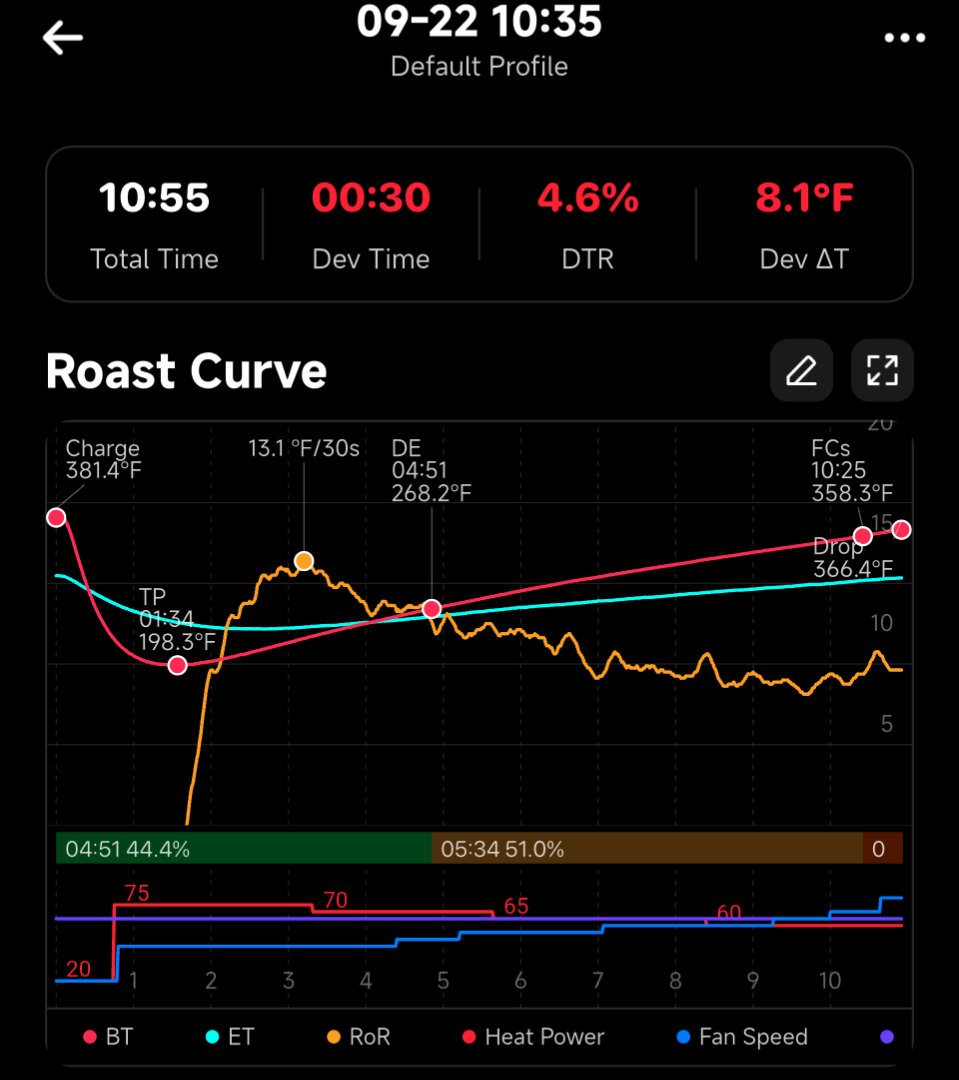
Sep 22 2026
Roast Details
| Roast Level | Time to FC | Drop Time | Charge Temp | Charge Weight | Final Weight | Loss % | Indoor Temp | Indoor Humidity |
|---|---|---|---|---|---|---|---|---|
| Light | 10:25 | 10:55 | 380°F | 380g | 335.6g | 11.7% | 57°F | 73% |
Notes
- Straightforward roast, light chaff
- Good light brown color at the end
- Smells very sweet during roasting
Roast log